



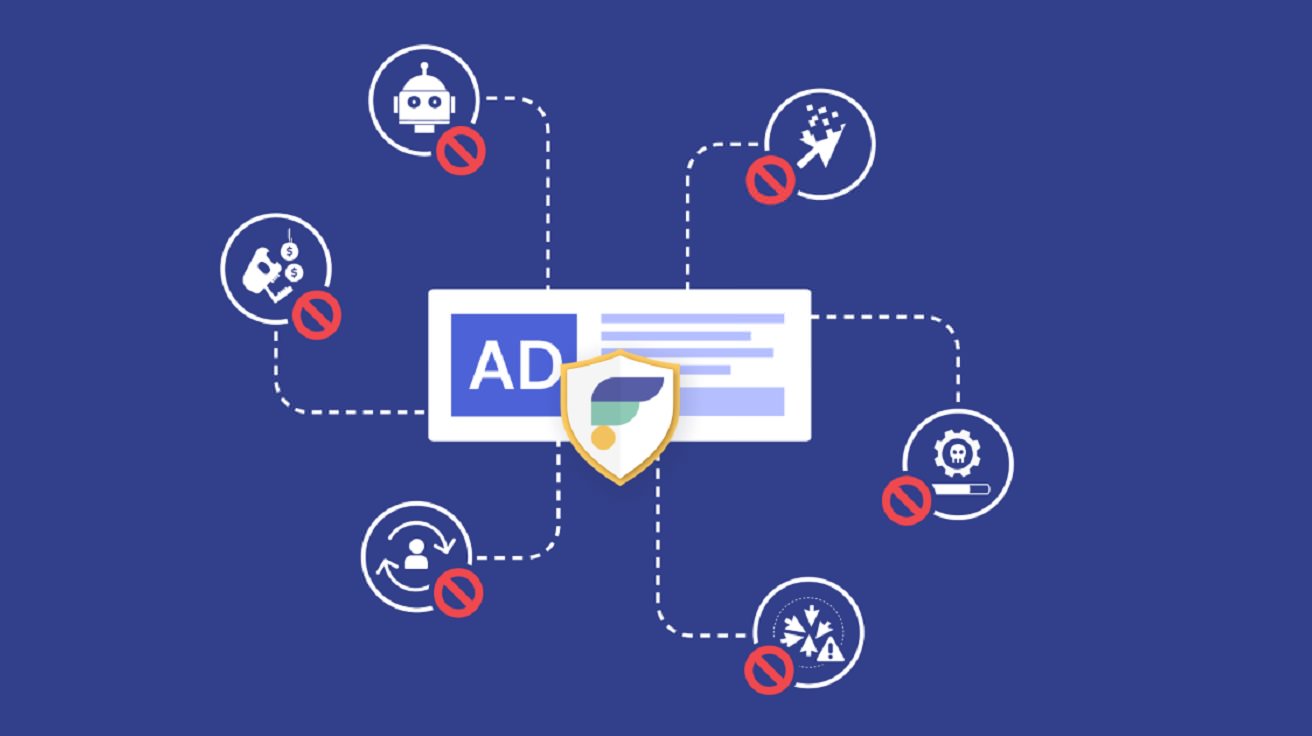
What is fraud traffic and why is it dangerous for business
Fraud traffic refers to fake clicks and impressions on your advertisements generated by bots, scripts, or unscrupulous competitors. Every single fake click deducts money from your advertising budget without bringing in a single real customer. According to the Association of National Advertisers, advertisers are projected to lose between $68 and $84 billion annually in 2025–2026 specifically due to fraudulent traffic. Learn more about fraud traffic.
The problem is compounded by the fact that modern bots have learned to masterfully mimic the behavior of human users: they scroll through pages, move the cursor, and linger on the site for the appropriate number of seconds. Your analytics display "normal" sessions, yet the money continues to drain.
"An advertiser sees beautiful metrics in their dashboard: thousands of clicks, low CPC, high CTR. But there are zero conversions. This is the classic symptom of fraud — the money is gone, there are no results, yet the system firmly believes everything is perfectly fine."
Exactly how fraud traffic destroys your ad budget: 5 mechanics
1. Direct Click Fraud
This is the most common scheme. Competitors or specialized botnets relentlessly click on your ads in Google Ads, Meta Ads, or other networks, artificially exhausting your daily budget. The result — your ads are paused in the middle of the day, exactly when your target audience is most active, while you pay for nothing.
Businesses in highly competitive niches are especially vulnerable: finance, legal services, healthcare, real estate, and e-commerce. The cost per click here is exorbitant, meaning even a few hundred fraudulent clicks a day can cost tens of thousands of dollars a month.
2. Data Poisoning
This is a covert and highly destructive form of fraud. Bots visit your site, mirroring the behavior of your ideal customers: they spend time on product pages, add items to the cart, and review delivery terms. Your advertising algorithm records these patterns and begins optimizing campaigns for this "audience."
Consequently, the platform's algorithm starts showing your ads to an increasing number of bots — because they "resemble" your best users. You are no longer scaling sales; you are scaling a systematic error.
3. Attribution Distortion
Fraudulent clicks severely skew the data regarding which channels and ads are actually working. You might notice one campaign showing an excellent CTR and reallocate your budget toward it — completely unaware that the high CTR is driven by bots, not real humans. Meanwhile, the genuinely effective channels are left underfunded.
4. Mobile App Metric Manipulation (Click Injection)
There is a specialized scheme targeting mobile applications called Click Injection. Malware on a user's smartphone monitors for real app installations and, just a millisecond before the installation completes, generates a "final click," falsely claiming credit for an organic user. You end up paying an affiliate network for a customer who found you on their own.
5. Retargeting Fraud
Retargeting is widely considered one of the most effective tools — you show ads to users who have already visited your site. However, if your retargeting pool is contaminated with bots, you are wasting your budget chasing non-existent users. According to traffic verification experts, up to 30% of retargeting audiences in certain niches consist entirely of fraudulent profiles.
How much are you losing right now?
Industry statistics indicate that, on average, between 10% and 25% of advertising budgets are lost to fraud traffic. For a company spending $50,000 a month, that translates to a pure loss of $5,000 to $12,500 monthly — money that will never yield a single sale.
Furthermore, standard platform tools — such as built-in protection from Google — only filter out the most obvious fraud. They are blind to complex schemes utilizing human behavioral imitation.
How to detect fraud traffic in your campaigns
There are several alarming signals you should look for in your analytics:
- High CTR combined with low conversion rates. Lots of clicks with almost zero leads or sales is the classic symptom of click fraud.
- Anomalous traffic spikes. Sudden surges in traffic at unusual times — such as late at night or during holidays — frequently point to bot activity.
- Suspicious geography. Clicks originating from regions where you do not operate and are not targeting your ads.
- Extremely rapid click velocity. If a single IP address clicks on your ad multiple times within a minute, it is unequivocally fraud.
- Zero time on site. Bots frequently bounce immediately, or conversely, show perfectly "round" session durations that look too mathematically precise to be human.
Why built-in platform protection is insufficient
Major platforms like Google indeed have their own anti-fraud systems and even issue refunds for some invalid clicks. However, this built-in protection has fundamental limitations.
First, ad platforms have an inherent conflict of interest when acknowledging the true scale of the problem — after all, every click, even a fraudulent one, generates revenue for them. Second, their algorithms are trained primarily on historical data and struggle to adapt to novel fraud schemes. Third, they lack the ability to comprehensively analyze post-click user behavior on your specific website — which is exactly where the full picture is revealed.
Independent anti-fraud systems operate differently: they analyze pre-click signals, in-the-moment click behaviors, and post-click site interactions to construct a multi-layered defense.
How ClikBy protects your advertising budget
The ClikBy platform leverages behavioral biometrics and ensemble machine learning to identify fraud across all stages of the advertising funnel. The system analyzes over 130 data points in real-time — ranging from technical device parameters to cursor micro-movements and scrolling patterns.
- Pre-charge blocking. Fraudulent clicks are identified and blocked before the ad platform has the chance to deduct the cost from your account.
- Data poisoning prevention. Bots are proactively excluded from your retargeting and lookalike audiences, ensuring platform algorithms train strictly on genuine users.
- Transparent reporting. You have full visibility into how many fraudulent clicks were blocked, their origin, and precisely how much budget was saved.
- Cross-platform compatibility. Seamlessly integrates with Google Ads, Meta Ads, and other major traffic sources.
The direct result of deploying ClikBy is real money that remains in your budget and is redirected toward acquiring genuine customers. You can also explore our case study, where we detail How we achieved a +30% increase in real app installs.
Bottom line: how much you can save
Companies that implement independent anti-fraud solutions typically save between 15% and 30% of their total ad spend. For a business with an annual budget of $1,000,000, that represents between $150,000 and $300,000 reclaimed — capital that now works to drive real growth rather than subsidizing fraudsters.
Connect anti-fraud protection for your advertising (Google Ads, Meta Ads, and other platforms)